AI & Higher Ed Priorities 2026

SIG surveyed Higher Education IT and enrollment leaders to find out how institutions are prioritizing artificial intelligence: what’s being funded, piloted, governed, and debated on campus right now. The survey ran in September 2026, with the majority of respondents holding CIO and senior executive-level positions at higher ed institutions across the country.
AI is a Top Priority — But It’s Not the Priority
Almost 40% of respondents say AI’s relevance to institutional strategic planning has “increased significantly” over the past 12 months, and another 45% say it’s “increased somewhat.” Nobody reported a decrease.
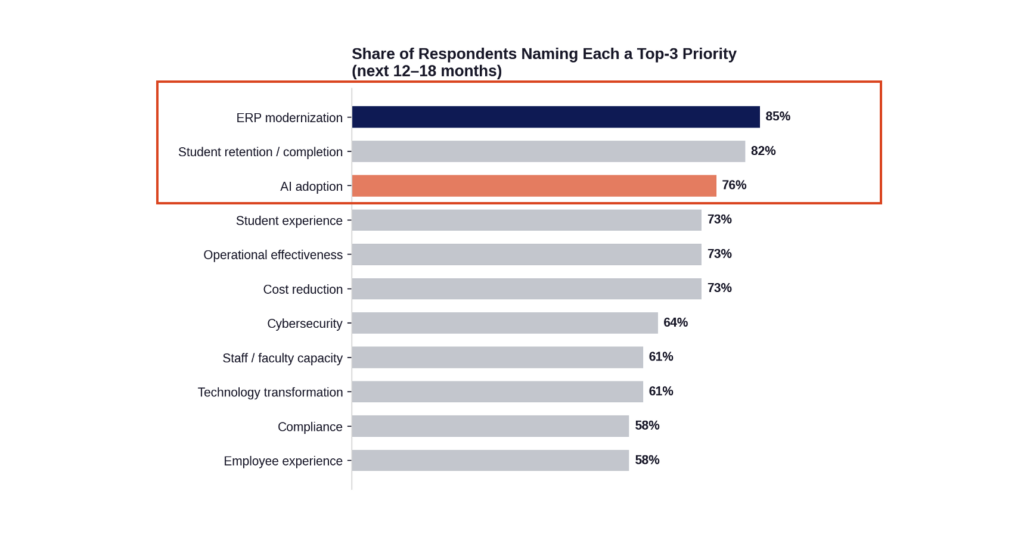
But when leaders were asked to name their institution’s top 3 priorities for the next 12 – 18 months, AI adoption placed third behind ERP modernization and student retention/completion, and roughly tied with cost reduction, operational effectiveness, and student experience. AI in these respondent institutions are competing with dollars and mindshare with a host of priorities.
Budgets Are Still Small, But Growing Fast
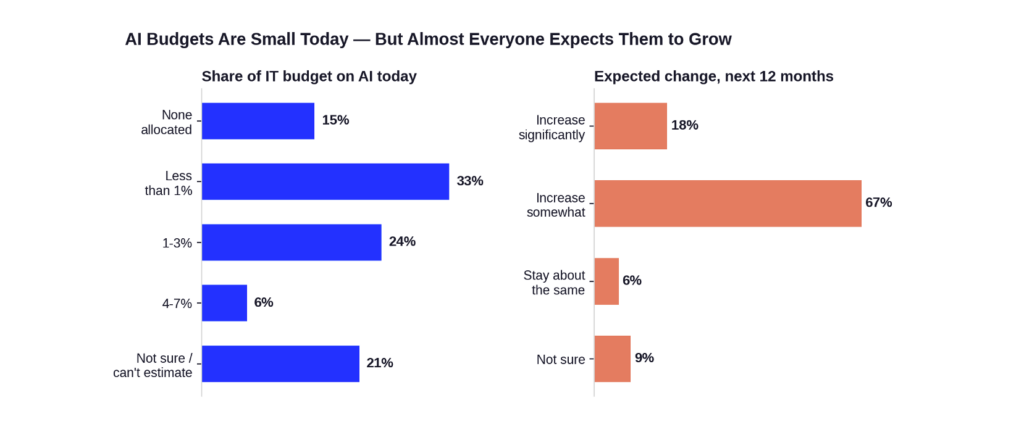
Despite AI’s rising strategic profile, actual dollars invested remain modest. Nearly half of respondents currently allocate less than 1% of their central IT budget — or nothing at all — to AI-related software, infrastructure, staffing, and consulting. Only 6% report allocating 6 – 7%.
The data suggest that will change in the near future. A striking 85% of respondents expect their AI budget to increase over the next 12 months, with two-thirds envisioning a moderate increase and 18% expecting significant growth.
IT Directors Feel Greater Urgency Than Their CIOs
IT Directors are far more likely than CIOs to say AI’s strategic relevance has increased significantly over the past year; 71% for IT Directors vs. just 27% for CIOs and VPs of IT. CIOs describe the shift as gradual (“increased somewhat,” 55%). The people closest to hands-on delivery are sensing urgency that hasn’t fully reached the top of the org chart yet. In contrast, the CIOs may have a more solid bird’s eye view of competing priorities.

What’s Competing for the Same Dollars
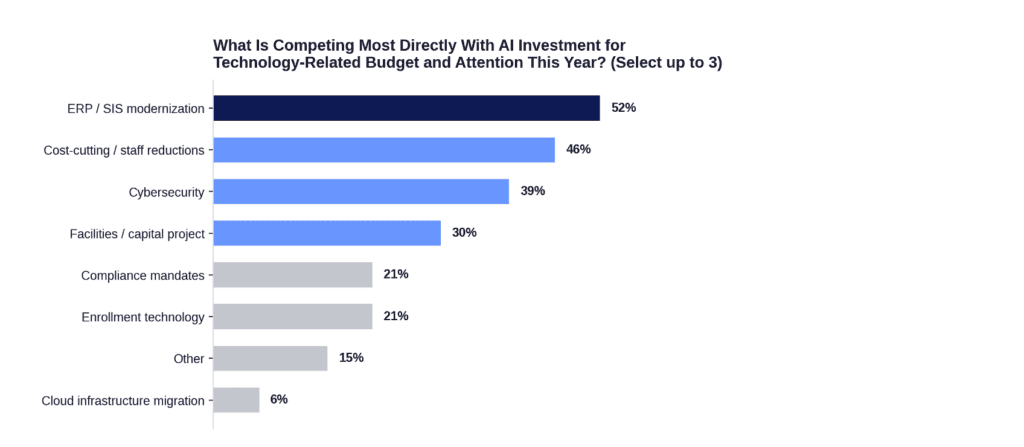
When asked what’s competing most directly with AI for technology budget and attention this year, ERP/SIS modernization topped the list at 52%, followed by cost-cutting/staff reductions (45%), and cybersecurity (39%).
Mind the “AI to Implementation” Gap
If AI adoption is a top-3 priority for 76% of institutions, what are these institutions evaluating and piloting and what have they implemented? The status of individual AI use cases tells a more nuanced story than the budget numbers alone.
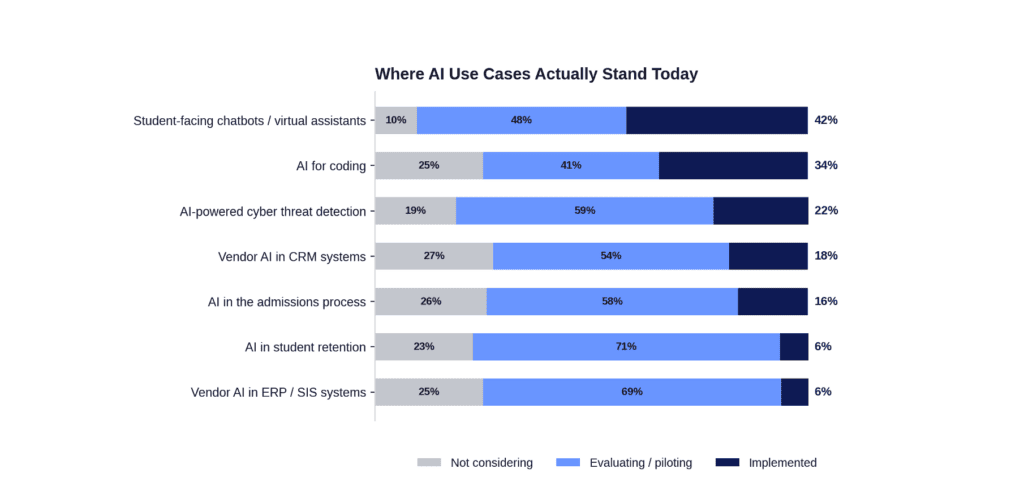
Student-facing chatbots and AI-assisted coding are the clear front-runners, with 42% and 34% of institutions reporting they’ve implemented them, respectively. Everything tied to core enrollment and retention systems are in earlier stages: only 6 – 7% of institutions have implemented AI within student retention workflows or vendor AI features inside their ERP/SIS and CRM platforms — though they are the areas that are being most piloted, which is aligned with the strategic priority of ERP modernization.
What’s Standing in the Way
We asked respondents to rate eight potential barriers to AI adoption. Topping the list were resources and readiness.
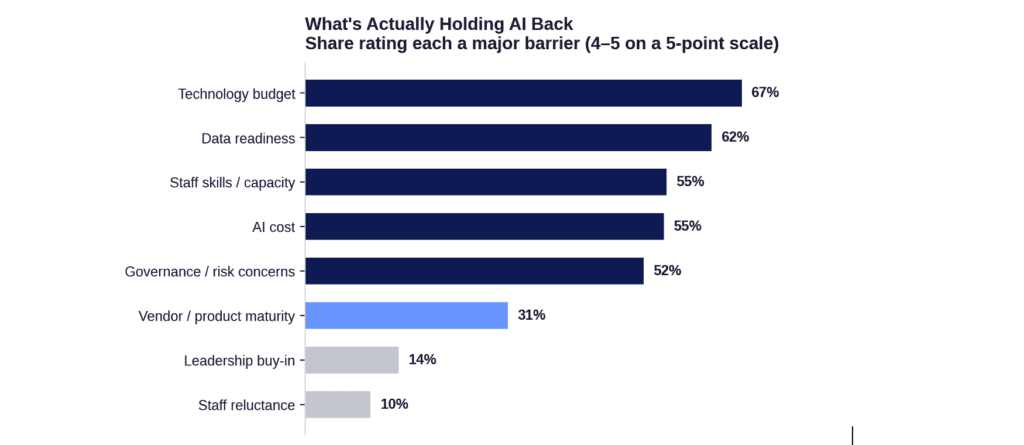
Technology budget (67% rate it a major barrier), data readiness (62%), staff skills/capacity (55%), and AI cost (55%) all outrank the softer, culture-coded concerns. What’s missing is money, clean data, and staff properly equipped to do the work.
Governance Is Catching Up — Ownership Still Isn’t Clear
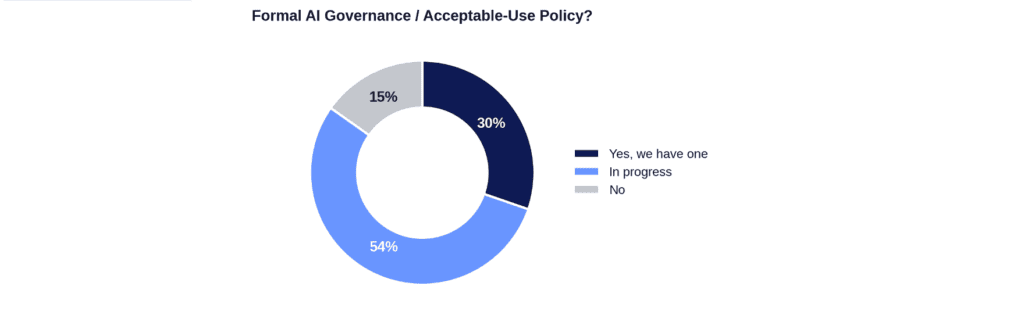
In our work with Institutions, SIG hears anecdotally a lot of concerns about AI Governance, security, and usage. And, while 52% of institutions cite Governance as a major barrier, the good news is 85% of institutions have either finished (30%) or are actively building (55%) a formal AI governance or acceptable-use policy. Only 15% have nothing in place.
The murkier picture is who’s actually driving the strategy day to day. CIO/IT leadership leads at 56%, and over a third of institutions (38%) rely on a cross-functional committee. But 28% — more than one in four — say there’s simply no clear owner of AI strategy at their institution.

Vendor Confidence Is Lagging Behind Institutional Ambition
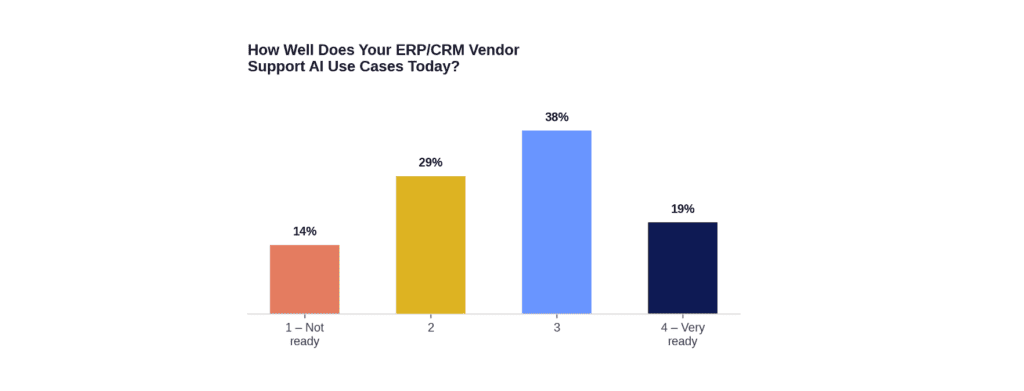
We asked respondents to rate, on a 4-point scale, how well their current ERP/CRM vendor supports AI-driven use cases today. The results cluster in the middle: a majority rate their vendor’s support as merely adequate (3) or worse, and only 19% give their vendor top marks.
Straight From the Source: Higher Ed Leaders in Their Own Words
The survey’s open-ended questions surfaced nuanced and candid feedback — on where the biggest integration hurdles are, where opportunity lies, and what they wish vendors understood.
Biggest Data/Integration Challenge
“Data sources are fragmented and siloed. Bringing all of this into one single platform or getting an inventory of the sources is the biggest challenge along with the data readiness and clean data.” — CIO/VP of IT, public 4-year institution (10,000–20,000 students)
“Too much of the conversation starts with the technology (AI) rather than the use case/problem to be solved.” — CIO/VP of IT, public 4-year institution (5,000–10,000 students)
Where the Biggest Opportunity Lies
“For a small, rural community college, AI offers the opportunity to overcome the limitations of scale — using data and intelligent automation to provide more personalized student support, operate more efficiently, and respond faster to the workforce needs of our region.” — CIO/VP of IT, community college (2,000–5,000 students)
“Student enrollment, retention, and success.”— CIO/VP of IT, community college (10,000–20,000 students)
What They Wish Vendors Understood
“The hard part isn’t the model, it’s our data infrastructure, staffing, and governance — so a demo that ignores those is selling us a pilot, not an outcome.” — CIO/VP of IT, community college (20,000–30,000 students)
“Stop selling me AI. Sell me a solution to a problem that I have.” — CIO/VP of IT, public 4-year institution (5,000–10,000 students)
What You Can Do Now: A Playbook for Institutions
These findings point to a handful of concrete moves institutions can make in the next two to three months — well before next year’s budget cycle locks in. SIG offers the following five recommendations, grounded directly in what your peers told us.
- Name an owner. With 28% of institutions reporting no clear owner of AI strategy, the single highest leverage move before your next planning cycle is simply assigning accountability to a person or a standing committee.
- Fund AI in alignment with other major strategic priorities. Retention and ERP/SIS are your top strategic priorities, yet AI is implemented in just 6% of them. Earmark a specific pilot budget for AI inside those systems so it doesn’t keep losing out to easier chatbot projects.
- Press vendors on AI. Only 19% of institutions rate their ERP/CRM vendor’s AI support as excellent. Before this budget cycle closes, ask for a concrete AI roadmap and seek examples of customers who have implemented AI solutions that are helping them address challenges similar to your own.
- Fix data readiness before adding another pilot. Fragmented, siloed data was the most-cited blocker in the open-ended responses. A short data inventory and governance sprint is often more valuable right now than a new AI initiative.
- Finish your governance policy while it’s still cheap to do. 55% of institutions are still in progress on formal AI governance. Closing it out now — especially if you’re a community college, where finished policies lag adoption the most — is far easier than retrofitting one later.
Ahead of EDUCAUSE 2026, SIG surveyed higher education IT and enrollment leaders to find out how institutions are prioritizing artificial intelligence on their campuses right now.
The survey ran in September 2026 and drew 39 respondents from public and private institutions across the country. Respondents skewed senior: nearly two-thirds are CIOs, VPs of IT, or senior IT executives, giving this data a strategic, budget-holder’s-eye view of AI in higher ed rather than a hands-on practitioner one.
Respondents were fairly evenly split between public four-year institutions (39%), private nonprofit four-year institutions (33%), and community colleges (25%) — with enrollment sizes ranging from under 2,000 students to over 20,000. Nearly two-thirds of respondents (64%) identified as a CIO, VP of IT, or senior IT executive, with another quarter as IT directors or senior IT managers.
Related Insights

Insights
BI Before AI: Why It’s High Time to Get Your Data Right
AI has dominated discourse across virtually every sector of our lives in 2026. It’s been no different in the world of higher ed technology. During Slate Summit in Nashville this summer, Technolutions touted the capabilities of Slate AI to transform the way we work in admissions, advancement, and student success....

Insights
Shadow AI on Campus: A 6-point Checklist to Spur Innovation While Staying Secure
78% of education employees report that their colleagues are using unauthorized AI tools. How do you address this growing security threat without punishing innovators?

Insights
Agentforce vs. Bots in Salesforce: Unleashing the Power of Advanced AI Agents
Rule-based bots handle tasks. Agentforce unleashes AI agents that act autonomously, adapt to complex scenarios, and deliver smarter, faster, data-driven outcomes across Salesforce.